
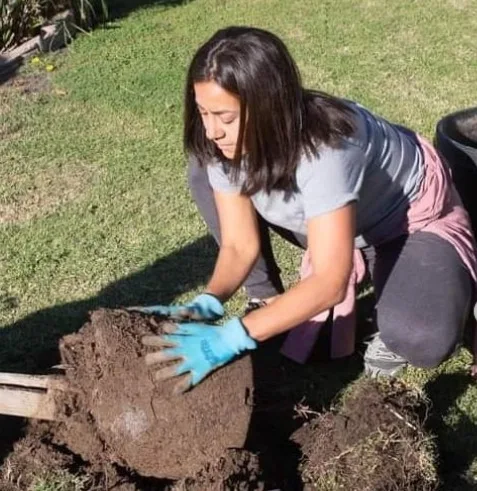
Rosemary Gavidia, leader at Grow Monrovia, says the group has now planted a little over 800 trees. In this Q&A, she discusses who cares for them after planting, where she sees gaps in Monrovia’s tree canopy, and what residents should consider when choosing and caring for trees. The answers below are hers.
1. Grow Monrovia says it has planted more than 600 trees, including more than 60 along East Foothill. What maintenance occurs after the initial watering and pruning period, and who remains accountable for each tree?
Grow Monrovia has now planted a little over 800 trees, including those installed through our residential and commercial projects. When we plant trees on private property, the property owner agrees to take responsibility for their ongoing care. This includes regular watering during the establishment period, typically the first one to two years, while the tree develops a stronger root system. Our involvement doesn't end with planting. We help with structural pruning during the first few years to encourage healthy growth and strong branch development. We also remain available by email to answer questions and address concerns as the trees mature.
Long term pruning is the responsibility of the property owner, although we offer discounted pruning services through our local tree care partners. We also educate residents about how and when to prune their trees so they can avoid unnecessary maintenance costs
Our goal is not just to plant trees, but to help residents grow healthy, long-lived trees that provide shade and environmental benefits for generations without becoming a financial burden to maintain.
2. Where are the city’s largest canopy gaps, and what canopy goal do you believe Monrovia should aim for?
Based on tree canopy mapping tools such as i-Tree and regional urban greening maps, some of Monrovia's largest canopy gaps are in the neighborhoods south of Foothill Boulevard, where tree coverage is approximately 12%, dropping to just 8% south of Duarte Road. Tree canopy coverage refers to the percentage of land shaded by trees when viewed from above. These numbers show a significant need for more trees, particularly along our main streets - Foothill Blvd, Duarte Rd, Mrytle Ave, etc.
American Forests recommends an average of 25-35% tree canopy coverage for urban areas in the dry western United States, with higher targets for some residential neighborhoods. I believe Monrovia should work toward a long-term goal of 30% canopy coverage in our developed neighborhoods, prioritizing areas with the least shade.
Expanding and maintaining our urban forest is about much more than beautifying our streets. Trees help reduce the urban heat island effect, where pavement, buildings, and other hard surfaces absorb and hold heat, making neighborhoods significantly hotter. Tree shade can make walking more comfortable, improve air quality, support wildlife, and contribute to better physical and mental health. Well-maintained trees can also make neighborhoods feel more welcoming and encourage people to spend time outdoors.
Increasing canopy coverage isn't just about planting new trees. Protecting our existing mature trees is more important. A large, established tree can provide far more shade than a newly planted tree, and it can take decades for a replacement to provide similar benefits.
I would like to see Monrovia establish measurable canopy goals, prioritize planting in neighborhoods with the greatest need, and strengthen protections for the mature trees we already have. Every neighborhood should have access to the benefits of a healthy urban forest, regardless of where residents live.
3. When planting trees, what should people consider about species, planting site, watering and mature size, and what mistakes most often kill young trees?
I'll focus on large shade trees because they require more planning, but they also provide some of the greatest benefits to our residents, neighborhoods, and local wildlife.
The first consideration is choosing the right tree for the right location. It's important to think about how large the tree will be in 20, 30, or even 50 years, not just how it looks when planted. Large shade trees need sufficient space for their roots and canopy to grow. As a general starting point, we recommend planting at least 10 feet from structures. Always call 811 before digging to identify underground utilities. Under overhead power lines, choose smaller species that will remain below the utility company's recommended height limit, generally 25 feet.
Watering is one of the most important factors in whether a young tree survives. For many of the 15-gallon trees we plant, approximately 15 gallons of water per week can be a starting point, but the amount and frequency depend on the species, soil, weather, and season. Trees need regular watering while establishing their roots, usually for the first one to two years for drought tolerant species. One common mistake is assuming that lawn sprinklers provide enough water. Trees planted in lawns should have their own watering system because their needs are different from those of grass.
Another common mistake is planting too deeply. The base of the trunk, where it begins to widen into the roots, should remain visible at or slightly above ground level. Burying this area can contribute to root problems, canopy die back and eventually kill the tree.
We also see problems with nursery stakes being left attached to trees after planting. These should be removed at planting. If the tree needs support, two stakes placed on opposite sides with flexible ties can help stabilize it while allowing the trunk to move naturally and develop strength. These temporary supports should be removed once the tree can stand independently.
Damage from lawn mowers and weed trimmers is another preventable cause of young tree decline. We recommend removing grass and other competing ground covers around the trunk and creating a wide ring of wood chip mulch, approximately 2-4 inches deep, keeping the mulch several inches away from the trunk. This protects the bark, conserves moisture, and improves growing conditions.
Some of the large trees that grow well in Monrovia include Coast Live Oak, Engelmann Oak, Valley Oak, Western Sycamore, Deodar Cedar and Italian Stone Pine. We especially encourage planting native species because they provide valuable habitat and food sources for local wildlife. Each species has different needs, so selecting the right tree for the available space is essential. Residents can message us at info@growmonrovia.org for advice on tree species to plant or with general tree health questions. They can also follow us on Instagram and Facebook or subscribe to our Website.
- Brad Haugaard


No comments:
Post a Comment